
The R Value Difference Between Rockwool, PIR Panel And PUR Panel: Core Material Guide
Jump to section
In modern construction, thermal efficiency drives design. The choice of insulation core directly dictates a building’s energy performance.
PIR and PUR panels are the clear leaders in R-value per inch, offering maximum insulation with minimal thickness. Rockwool, by contrast, requires significantly more depth to achieve the same thermal resistance, though it compensates with superior fire and acoustic properties.
Ultimately, the decision involves a trade-off: do you prioritize the space-saving efficiency of foam, or the non-combustible safety of mineral fiber? This guide compares the numbers to help you decide.
What Is R-Value and Why Does It Matter?
R-value measures thermal resistance, or how well insulation resists heat flow. A higher R-value means better thermal efficiency because less heat sneaks through.
Testing usually follows ASTM C518, which measures how well a material blocks heat under controlled conditions. R-value depends on the type of material, its thickness, and density.
Dense stuff like stone or concrete lets heat move more easily than rigid foam insulation such as PIR (polyisocyanurate) or PUR (polyurethane) panels. In practice, a wall with high R-value insulation helps keep indoor temperatures steady and reduces energy loss.
The formula’s simple:
R = thickness ÷ thermal conductivity.
So, thicker layers or materials with low conductivity give you more resistance to heat flow. Here’s a quick look at typical R-values for common insulation materials:
- Rockwool: 3.0–3.3 (≈0.52–0.58 m²·K/W) per inch – Non-combustible, lets vapor move through
- PIR Panel: 6.0–6.5 (≈1.06–1.14 m²·K/W) per inch – High thermal resistance even in thin layers
- PUR Panel: 5.5–6.0 (≈0.97–1.06 m²·K/W) per inch – Lightweight, strong insulation
Choosing the right R-value really shapes thermal performance and energy use. Higher R-value insulation slows heat transfer, keeping spaces warmer in winter and cooler in summer.
The Data: R-Value Per Inch Comparison
R-values show how well insulation resists heat flow. Even small differences in R-value per inch can change how thick a wall or roof needs to be to meet energy codes or design targets.
PIR & PUR (Polyurethane) Panels
Polyurethane-based panels, including PIR (polyisocyanurate) and PUR, give some of the highest insulation values among rigid foam boards.
- Structure: These foams use a closed-cell core that traps blowing gases with low thermal conductivity. This design helps them reach R-6.0 to R-8.0 per inch, depending on the formula and age.
- Cause: The trapped gas acts as the main thermal barrier instead of air, so you can hit a target R-value with less thickness.
- Composition: PIR panels have a cross-linked structure, making them more stable at higher temperatures than PUR.
- Application: Builders usually pick PIR for roofs and walls where space and fire resistance matter, while PUR is common in cold storage and refrigeration.
This design difference between PIR and PUR means small changes in density, chemical bonds, and gas retention can tweak the R-value per inch. Thinner insulation at a given performance level means simpler framing and more usable space.
Rockwool (Mineral Wool) Panels
Rockwool insulation, also called mineral wool, usually gives you R-3.6 to R-4.2 per inch depending on density. The fibers come from melted basalt rock spun into mats that trap air.
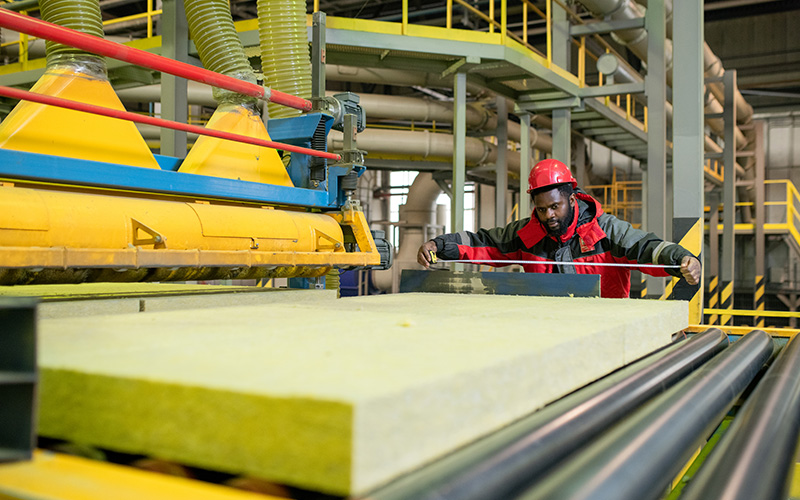
- Structure: The open-fiber structure traps air, not gas, which lowers R-value but boosts fire and sound resistance.
- Cause: Air transfers heat faster than the gas used in closed-cell foams, so mineral wool must be thicker to match the same thermal performance.
- Application: You’ll see Rockwool panels in exterior walls, vapor-open roofs, and places where fire resistance or noncombustibility matter most.
This translates to better fire safety, but you’ll need thicker wall sections compared to PIR or PUR panels with the same thermal resistance.
Comparative Table
- PIR Panel (Polyisocyanurate): R-6.0–8.0 per inch, Lambda 0.025–0.021 W/m·K, Used for roofs, wall panels, curtain walls
- PUR Panel (Polyurethane): R-5.5–6.5 per inch, Lambda 0.028–0.024 W/m·K, Used for cold rooms, wall cores, refrigeration
- Rockwool (Mineral Wool): R-3.6–4.2 per inch, Lambda 0.040–0.037 W/m·K, Used for fire-rated walls, exterior facades, ceilings
The Thickness Penalty: Real-World Implications of R-Value
Insulation materials hit the same thermal resistance in different ways. Rockwool needs more thickness than rigid foams like PIR and PUR, which changes design, cost, and available space in both wall and roof insulation systems.
Case Study: The Target R-30 Scenario
A “thickness penalty” means materials with lower R-value per inch must be installed thicker to get equal insulation performance.
- PIR panel: about R-7.5 per inch, so you need ~4 inches to reach R-30.
- PUR panel: about R-6.5 per inch, needing about 4.6 inches.
- Rockwool: about R-3.8 per inch, so around 7.9 inches.
Because Rockwool insulates less per inch, walls and roofs must be almost twice as thick. This difference impacts sandwich panel design, since foam core thickness determines both weight and joint geometry.
Builders end up with thicker walls, heavier panels, and changes to structural details. A Rockwool panel that meets R-30 can weigh nearly twice as much as a PIR panel with the same rating.
Extra thickness can force changes to window openings, façade brackets, and corner trims, which affects both labor and on-site layout decisions.
Hidden Costs of Thicker Panels
Thicker insulation doesn’t just take up more space—it also changes logistics and installation economics.
- Interior Space: In places like cold storage or processing plants, losing 3–4 inches per wall can shrink usable area for shelving or equipment.
- Transport: Bulkier sandwich panels fill up trucks faster, so you get fewer panels per load. That means higher fuel and freight costs.
- Installation: More thickness calls for longer fasteners, deeper flashings, and bigger trims. These details add cost and slow down installation.
For building owners, this means higher up-front construction costs and trickier coordination. While Rockwool brings strong fire and sound performance, its thickness requirement is a real trade-off in design and logistics.
Beyond The Numbers: Stability And Aging (LTTR)
How well insulation holds its R-value over time depends on its structure and how gases or moisture interact with it. Some foams lose a bit of their insulating gas, while mineral fiber materials stay stable since their performance relies on air pockets that don’t really change with age.
PIR/PUR And Thermal Drift
Thermal drift is the gradual change in insulation performance as trapped gases escape or get replaced by air.
- Cause: Polyisocyanurate (PIR) and polyurethane (PUR) panels use closed-cell foam with blowing agents that have very low thermal conductivity. Over time, some of these gases slowly leak out while air seeps in. This can drop the R-value a bit, because air isn’t as good an insulator.
- Measurement: The Long-Term Thermal Resistance (LTTR) method, defined by ASTM C1303 and CAN/ULC-S770, predicts a 5-year aged R-value. This value is pretty close to the average performance over a 15-year service life.
- Design Implication: The labeled LTTR R-value already factors in expected aging. A PIR panel rated at R-6 per inch might measure around R-6.5 when new, but it settles near R-6 after a few years.
- Moisture Resistance: PIR foam often uses facers like aluminum foil or coated fiberglass to create a strong moisture barrier. These layers help stop water from getting in and protect the foam cells from performance loss due to humidity.
- In Practice: Builders can count on published LTTR values for long-term planning. It gives a consistent way to compare aged thermal performance across different foam insulation products.
Rockwool Stability
Definition: Rockwool stability means the material keeps its R-value over time because it relies on its structure, not trapped gases.
- Composition: Rockwool, or mineral wool, comes from spun volcanic rock fibers that surround dry air. There aren’t any special gas fills like in foams, so you don’t get that slow loss of insulation value over time.
- Aging Effect: Its fibers and air pockets stay put for decades, so Rockwool’s R-value barely changes. Tests have shown it barely budges, even after many freeze–thaw or humid cycles. For you, this means its insulating power pretty much stays steady as long as your building stands.
- Moisture Resistance: The fibers repel water but still let vapor through. That allows any trapped moisture to dry out, cutting down the risk of mold or rot. So, the insulation can breathe and stay dry, without locking in vapor.
- Durability Factor: Rockwool won’t shrink, warp, or give off gases. You don’t need to adjust its R-value for long-term reporting. What you see on the label is what you get, even years later.
The Trade-Off: When To Sacrifice R-Value For Safety?
A high R-value tells you a material blocks heat well, but sometimes safety matters more. Polyisocyanurate (PIR) and Polyurethane (PUR) panels hit about R‑6 to R‑6.5 per inch, which is nearly double what Rockwool offers—usually R‑3.7 to R‑4.3 per inch. But here’s the catch: these foams use organic compounds, and even with fire retardants, they’re still combustible.
Rockwool is made by melting basalt rock at crazy-high temps. It’s non-combustible and gets an A1 rating for fire performance. Its fibers can handle over 1,000°C (1,800°F) and won’t spit out toxic smoke or feed a fire. In real-world terms, Rockwool slows fire spread in walls and ceilings—giving people or valuables a bit more time to escape or stay safe.
PIR and PUR, though, need a thermal barrier like drywall to meet fire safety codes. Their high R-value comes from gas-filled foam cells that trap heat, but that same structure burns when things get hot enough. You get better energy savings, sure, but you also need to follow stricter installation and safety rules.
Decision Matrix
| Primary Goal | Material Choice | Key Reason |
| Maximize R‑value | PIR / PUR | Highest thermal efficiency per inch |
| Maximize fire resistance | Rockwool | Fully non-combustible, withstands >1000°C |
| Balance both (code areas) | PIR + Fire Barrier | Higher R‑value with regulated fire protection |
Choosing insulation really depends on which risk you worry about more: heat loss or fire exposure.
Material Comparison
When you stack up R-values, PIR and PUR panels both deliver more insulation per inch than rock wool. PIR clocks in at about R-6.5 to R-7.0 per inch, PUR hits R-6.0 to R-6.5 per inch, and Rockwool usually sits around R-4.0 per inch.
PIR and PUR get those higher R-values from their closed-cell foam structure. Gas molecules inside slow heat movement. So, you need less wall thickness to hit your target thermal limits—saving weight and materials.
Rock wool, while bulkier for the same insulation, brings non-combustible composition and solid acoustic control. That’s a big win where fire-rated assemblies or soundproof spaces are a must-have.
If your main goal is energy savings and thin wall design, PIR or PUR panels take the prize. If you care more about safety and sound performance, rock wool’s the steady choice.
Honestly, it’s worth talking to the technical team if you want to nail down the exact panel thickness you’ll need to hit your project’s U-value or R-value targets.
Frequently Asked Questions
Can Rockwool’s R-value compete with PIR and PUR?
Not inch-for-inch. Rockwool typically has an R-value of R-3.6 to R-4.2 per inch, while PIR and PUR range from R-6.0 to R-8.0. This means Rockwool panels must be nearly twice as thick to achieve the same insulation performance as foam panels.
What affects the R-value stability of these materials?
Moisture and Aging.
- PIR/PUR: Their high R-value relies on trapped gas. Over years, slight gas exchange can cause “Thermal Drift” (minor R-value drop), though metal facings largely prevent this.
- Rockwool: It is physically stable and retains its R-value indefinitely unless it gets wet, which significantly degrades performance.
Which core is the most energy-efficient overall?
PIR is the winner for pure energy efficiency, offering the highest thermal resistance in the thinnest profile. PUR is a close second. Rockwool is less energy-efficient per inch but is the superior choice when fire safety (A-rated) or soundproofing is the priority over thickness.
Want to Know More About Our Products?
View All Products Now