
PIR vs PUR vs Rockwool Sandwich Panels: Differences, Performance & Best Uses
Jump to section
PIR, PUR, and Rockwool sandwich panels differ mainly in insulation performance, fire resistance, and acoustic properties, making each best suited for specific building needs. These core materials define how a panel performs, from maintaining thermal comfort to ensuring safety standards are met. In construction and manufacturing, choosing the right core impacts energy efficiency, durability, and long-term cost control.
Industry experts recognize that PUR panels offer strong thermal insulation at an affordable cost, PIR panels improve fire performance while keeping high insulation levels, and Rockwool panels excel in sound control and fire resistance. Each material serves a distinct purpose, which makes understanding their composition and benefits essential for selecting the right panel type.
This article explains how core materials influence panel performance, compares PIR, PUR, and Rockwool across key criteria, and shares practical guidance for choosing the most suitable option for different applications. It also highlights common mistakes and misconceptions to help ensure reliable and safe installations.
Why Core Material Matters in Sandwich Panels
A sandwich panel combines two rigid metal skins, steel or aluminum, bonded to an insulating core. This core is the panel’s main functional layer, controlling how it performs in insulation, strength, and resistance to fire or moisture.
The core type determines key properties:
- Thermal performance – how well it resists heat transfer
- Fire behavior – how it reacts to and slows the spread of flames
- Acoustic performance – how well it reduces noise transmission
- Structural efficiency – how much load it can carry without bending
- Durability and cost – how long it lasts and how much it costs to install
PIR, PUR, and Rockwool Sandwich Panels
What Is PUR (Polyurethane) Foam?
PUR (Polyurethane) foam is a rigid, closed-cell insulation made from reacting polyols with an isocyanate component. The resulting structure forms a dense matrix of tiny, sealed cells that trap gas, limiting heat transfer. This composition gives PUR foam its low thermal conductivity, typically around 0.022–0.024 W/m·K.
Inside a PUR sandwich panel, the foam is injected or foamed in place between two metal facings, usually steel or aluminum. The foam expands to fill the cavity, bonding tightly to the skins during curing. This creates a strong composite panel with excellent thermal insulation at relatively low thickness.
PUR panels suit walls and roofs in industrial, commercial, and agricultural buildings where energy efficiency and light weight matter more than high fire performance.
What Is PIR (Polyisocyanurate) Foam?
PIR (Polyisocyanurate) foam is chemically related to PUR but has more isocyanurate rings formed during polymerization. These additional ring structures create stronger chemical bonds, giving PIR foam better thermal stability and improved fire resistance compared with PUR.
The foam remains closed-cell and rigid but resists ignition and retains shape longer at high temperatures. It offers thermal conductivity around 0.021–0.023 W/m·K. During production, PIR foam is continuously foamed between metal facings to create PIR sandwich panels with uniform insulation and structural integrity.
Typical advantages:
- Higher fire rating (Bs1d0 or equivalent)
- Stable insulating value over time
- Suitable for regulated environments
PIR panels are common in cold storage, warehouses, and public or industrial buildings that require reliable fire safety without sacrificing insulation quality.
What Is Rockwool (Mineral Wool)?
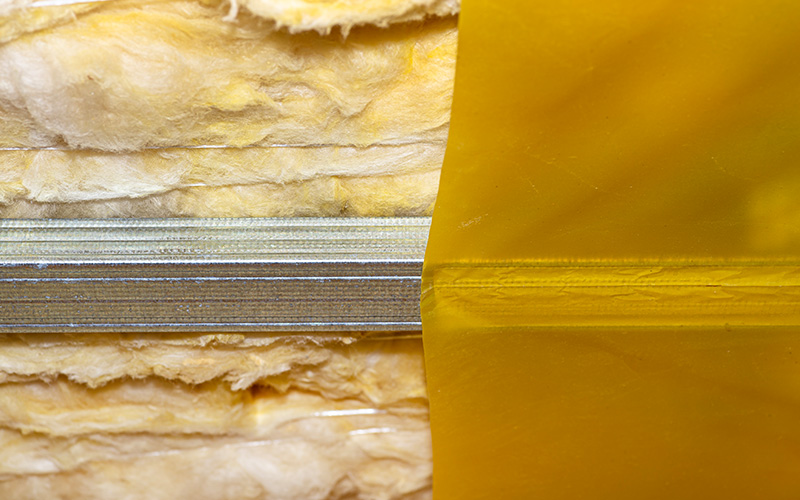
Rockwool, also called mineral wool, is made by melting natural basalt rock and slag at high temperature and spinning the molten material into fine fibers. The resulting core contains interwoven mineral strands with open pores that trap air, producing both thermal and sound insulation. Unlike foams, Rockwool is non-combustible, with an A1 fire classification under EN standards.
A rock wool sandwich panel bonds this fiber core between metal sheets using adhesives or mechanical fixing. The density typically ranges from 100–150 kg/m³, giving the panel rigidity and dimensional stability.
Rockwool panels provide superior fire and acoustic performance, making them ideal for fire-rated partitions, data centers, power stations, and buildings near heavy noise sources.
What are Differences Between PIR, PUR, and Rockwool?
PIR, PUR, and Rockwool differ mainly in their core materials, which define how each performs in insulation, fire safety, moisture control, and sound absorption. Their unique chemical or mineral structures lead to distinct strengths and trade-offs that determine where they work best in buildings and industrial uses.
Thermal Insulation Performance
PIR (Polyisocyanurate) panels deliver the highest thermal insulation among the three materials. They typically have a thermal conductivity of 0.022–0.025 W/m·K, meaning thinner panels can achieve the same energy performance as thicker alternatives. This makes PIR ideal for applications needing strict thermal efficiency, like cold storage or temperature-controlled spaces.
PUR (Polyurethane) panels have slightly higher thermal conductivity, usually 0.025–0.028 W/m·K. They still provide excellent insulation for residential, commercial, and agricultural buildings but may require greater thickness to match PIR’s performance levels.
Rockwool panels, made from volcanic rock fibers, perform less efficiently in thermal insulation, with a value around 0.037–0.040 W/m·K. However, they offer better performance at high temperatures and maintain insulation value even after long-term exposure to heat.
Fire Resistance and Fire Rating
Rockwool panels show the best fire resistance due to their mineral composition, which is naturally non-combustible. They can achieve Euroclass A1 fire ratings and handle temperatures above 1,000°C without melting or releasing smoke. This makes them suitable for high fire-risk environments such as power plants and industrial enclosures.
PIR panels also perform well in fire situations. Their chemical structure forms a stable carbonized layer when exposed to heat, slowing fire spread. They typically meet Euroclass B-s1,d0 ratings, showing limited flame propagation and low smoke formation.
PUR panels offer lower fire performance, usually achieving Euroclass C-s3,d0. They melt more easily than PIR and Rockwool, so they are better used in non-critical fire zones or where cost constraints outweigh higher fire ratings.
Moisture Resistance and Durability
PIR and PUR panels are both closed-cell foams, naturally resistant to water absorption and vapor transfer. Their low moisture uptake helps prevent mold growth and preserves insulation value over time. These properties also improve dimensional stability under varying humidity and temperature conditions.
Rockwool panels have open fibrous structures that can absorb some moisture if unprotected. When properly sealed or coated, they can still perform well in damp environments, but without protection, their thermal efficiency can drop. However, Rockwool remains dimensionally stable even when wet and can dry out without damage.
For high-humidity applications, PIR and PUR panels often perform better, while Rockwool is preferred where fire resistance outweighs minor moisture concerns.
Sound Insulation
Rockwool panels outperform PIR and PUR in sound insulation. Their fibrous and porous texture absorbs airborne noise effectively, offering sound reduction ratings (Rw) often above 35–40 dB, depending on panel thickness. This makes them ideal for walls or roofs near busy roads, factories, or indoor partitions needing acoustic control.
PIR and PUR panels, being closed-cell foams, reflect more sound than they absorb. They typically achieve Rw ratings of 25–30 dB, providing limited noise reduction. However, they can still reduce mechanical and impact noise when combined with other acoustic layers or wall assemblies.
Where both thermal and acoustic insulation are required, Rockwool panels provide a good balance of performance and cost efficiency.
Mechanical strength & weight
PIR and PUR panels offer a strong yet lightweight structure. They maintain high compressive strength, often above 150–200 kPa, while keeping panel weight low. This combination is valuable for long-span roofs or cladding where reduced load on the frame is important.
PIR is more rigid and less prone to deformation than PUR, making it better for structural panels or areas under mechanical stress. PUR is slightly more flexible, which helps during installation but can lead to minor deformation under heavy loads.
Rockwool panels are denser and heavier. Although compressive strength ranges around 80–120 kPa, the higher weight increases installation effort. However, their density helps absorb impact and vibration, which benefits industrial uses.
Initial Cost vs Operational Cost
In most cases, PUR panels have the lowest initial cost, making them popular for projects on tight budgets. They still offer good thermal insulation and moisture protection, giving strong value for the price.
PIR panels cost more upfront but offer long-term energy savings through higher insulation efficiency. Their improved fire performance can also reduce insurance and maintenance costs over a building’s life.
Rockwool panels come with moderate to high purchase costs due to heavier weight and more complex manufacturing. However, they can lower operational risks by ensuring non-combustibility, long service life, and minimal thermal degradation over time.
Recyclability, Material Efficiency
Rockwool stands out for recyclability and environmental durability. It can be reused or reprocessed without losing structural integrity and is often made from natural or recycled stone materials. Manufacturing waste can be melted back into production, reducing landfill impact.
PIR and PUR foams are less recyclable. Their chemical structure limits reuse, and they are usually downcycled into less demanding applications. However, new formulations aim to improve recovery of polyols for closed-loop recycling, and their high insulation efficiency reduces lifetime energy use.
When considering material efficiency, PIR panels deliver more insulation per thickness, saving space and materials in construction. Rockwool provides excellent longevity and non-toxic disposal, while PUR offers good insulation with moderate environmental cost.
What are key considerations when choosing the core materials of sandwich panels?
Selecting the right core material depends on the demands of the building, required fire and energy performance, and how project costs align with long-term durability goals. The properties of PUR, PIR, and Rockwool cores affect insulation efficiency, fire rating, strength, and overall cost-effectiveness over a building’s life cycle.
Choose by Building Type
Different building types need different thermal and fire performances. Industrial and cold storage buildings often use PIR cores for their low thermal conductivity (around 0.022–0.025 W/m·K), giving excellent insulation with thinner panels. PUR cores (about 0.025–0.028 W/m·K) still perform well but suit projects where extreme insulation is not critical.
Rockwool cores, made from mineral fibers, provide high fire resistance and sound absorption. They perform well in public buildings, hospitals, or multi-occupancy spaces where safety and noise control matter more than light weight.
Designers often weigh mechanical strength, weight, and installation ease. PIR and PUR panels are lighter and easier to handle, while Rockwool panels are heavier but add better acoustic and fire performance.
| Core Material | Typical Use | Key Strength |
| PIR | Cold storage, food processing | Thermal efficiency |
| PUR | Warehouses, commercial | Cost balance |
| Rockwool | Public or fire-rated buildings | Fire resistance |
Choose by Code & Certification Requirements
Local codes and insurance guidelines often determine acceptable materials. Fire performance ratings are a major factor. PIR panels commonly achieve Euroclass B or better, while PUR usually rates B–C, and Rockwool can reach Euroclass A1, the highest classification for noncombustible materials.
Projects in healthcare, residential, or public sectors must often meet stricter fire-resistance and smoke-toxicity limits. PIR and Rockwool panels are preferred in these environments for safer evacuation times and reduced flame spread.
Environmental certifications like BREEAM, LEED, or national green standards may also guide selection. Panels using recycled or bio-based polyols in PIR cores help meet sustainability goals, while mineral-based Rockwool panels already satisfy many environmental benchmarks due to their inert composition.
Choose by Budget and Life-Cycle Expectations
Budget and long-term value influence most final choices. PUR panels cost less upfront and provide solid performance for short- to medium-term buildings such as warehouses or agricultural facilities. PIR panels, while 10–20 % more expensive, deliver lower energy consumption over time through better thermal efficiency and durability.
Rockwool panels have a higher material and installation cost because of their density, but their noncombustibility and long service life can offset these costs in high-safety projects. They also reduce future costs related to fire protection upgrades or insurance premiums.
When considering life-cycle cost, decision-makers often use metrics like R-value retention, maintenance needs, and expected service life (typically 25–40 years for PUR/PIR, 40+ years for Rockwool) to balance immediate expenses against long-term performance.
How to Choose the Right Core Materials for Sandwich Panels?
Selecting the insulation core depends on thermal performance, fire resistance, weight, and cost. Each material—PUR, PIR, and Rockwool—serves specific building needs and energy targets based on its structure and insulation properties.
Best Use Cases for PUR Panels
PUR cores work well for keeping buildings comfortable without requiring excessive panel thickness.
These panels suit warehouses, workshops, agricultural buildings, and cost-sensitive commercial spaces. Their light weight simplifies installation and reduces structural load requirements.
PUR panels perform best in regions with moderate climates where strict fire performance or extreme temperature control is not the main concern. They also support various finishes, making them flexible for both roofing and wall applications.
Best Use Cases for PIR Panels
PIR (Polyisocyanurate) panels improve on PUR by offering better thermal insulation (around 0.022–0.025 W/m·K) and higher fire resistance. Their cross-linked chemistry allows the foam to char instead of melt, limiting fire spread and maintaining structure longer under heat.
These panels are ideal for cold storage facilities, food processing plants, hospitals, schools, and industrial buildings where energy efficiency and fire performance are priorities. Thinner PIR panels can meet the same insulation targets as thicker PUR options, saving space and structural weight.
Although PIR costs more, it helps reduce long-term energy use through lower heat loss. Builders often choose PIR for compliance with high insulation standards in temperature-controlled or safety-regulated buildings.
Best Use Cases for Rockwool Panels
Rockwool (or mineral wool) panels use natural stone fibers to provide excellent fire and acoustic performance. While their thermal conductivity (~0.036–0.040 W/m·K) is higher than PUR or PIR, they maintain stable insulation at high temperatures and are fully non-combustible.
Rockwool cores fit best in industrial plants, public buildings, data centers, and facades where fire safety, sound control, or non-combustibility are essential. Their density also improves structural rigidity and sound dampening, making them ideal for mechanical rooms or fire-rated walls.
Though heavier and less efficient for strict energy-saving goals, Rockwool panels excel in applications requiring compliance with high fire classifications or acoustic comfort standards.
Common Misconceptions & Mistakes to Avoid
Misconception 1: All PIR panels have the same fire rating.
In reality, fire performance varies a lot depending on panel thickness, core density, facing materials, and installation quality. Many PIR products achieve Euroclass B, but some may not if manufacturing or installation is poor. For fire-sensitive projects, always check certified test data.
Misconception 2: PUR panels are safe to use in humid or wash-down environments.
This is a common mistake. Over time, PUR can absorb small amounts of moisture, reducing insulation performance and potentially causing delamination. PIR resists moisture better; Rockwool remains dimensionally stable but still needs good sealing to prevent water migration.
Misconception 3: Price alone is enough to choose the right panel.
Comparing only upfront cost often ignores thermal needs, fire safety, and structural strength, leading to lower performance and higher maintenance later. The right approach is to evaluate R-value, fire class, load/strength requirements, and project conditions together before selecting a panel.
Frequently Asked Questions
Is PIR panel fire resistant?
PIR (polyisocyanurate) panels have strong fire resistance compared to standard polyurethane types. Their chemical structure forms a stable isocyanurate ring, which resists heat and slows flame spread.
In testing, PIR panels typically earn a Euroclass B or better fire rating, meaning they limit combustible gases and maintain structural integrity longer under high heat. They char instead of melting, which helps reduce ignitability.
This makes PIR panels suitable for applications with higher fire safety standards, such as industrial facilities, warehouses, and public buildings.
PUR vs PIR for cold rooms?
Both PUR and PIR panels work well for cold storage, but their efficiency differs. PIR panels have a lower thermal conductivity of about 0.022–0.025 W/m·K, while PUR panels measure around 0.025–0.028 W/m·K.
Because of this, PIR panels achieve the same insulation with thinner material. They also provide better dimensional stability when exposed to temperature fluctuations.
PUR panels remain the more economical option and perform effectively when temperature demands are moderate. For long-term or low-temperature storage, PIR panels deliver improved performance and durability despite their higher cost.
Want to Know More About Our Products?
View All Products Now