
The Complete Guide to Designing an Energy-Efficient Cold Storage Warehouse: Reduce Costs and Carbon Footprint
Cold storage warehouses are energy-intensive assets that operate 24/7. Consequently, even minor design flaws—such as weak insulation, air leaks, or inefficient layouts—compound into massive financial losses over time.
True efficiency isn’t just about buying better compressors; it starts with the architecture. A high-performance facility must treat energy conservation as the central design principle, integrating an airtight thermal envelope with high-density storage and smart mechanical systems.
This guide provides a step-by-step framework for designing a cold storage warehouse that minimizes heat infiltration and maximizes ROI, ensuring your facility is built for long-term profitability from day one.
How Do You Design an Airtight Thermal Envelope?
An airtight thermal envelope is the continuous barrier system that limits air leaks, heat flow, and moisture transfer between a cold storage warehouse and the outside environment.
- Insulation Design: The building envelope relies on materials with verified thermal resistance (R-value). For example, insulated metal panels (IMPs) often provide R-values between R-30 and R-45 when using rigid polyurethane cores. These panels reduce conductive heat loss, which keeps mechanical refrigeration loads stable. In practice, this means the facility maintains colder temperatures using less energy.
- Continuous Air and Vapor Barriers: Every surface—walls, roofs, and floors—must include continuous vapor barriers to stop moisture migration. Designers typically apply polyethylene sheet membranes or closed-cell spray foam at junctions to seal gaps. Because moisture reduces insulation performance and promotes frost buildup, these layers protect long-term energy efficiency.
- Sealing Critical Joints: Transitions where the wall meets the roof or floor are weak points. Builders use butyl or silicone sealants with taped seams to maintain airtight continuity. When every joint is sealed, the system prevents uncontrolled air exchange, which could otherwise raise humidity inside storage zones.
- Underfloor Protection: In cold chambers, frost heave can occur when the ground freezes under the slab. Installing thermal breaks and glycol-heated or electric underfloor systems prevents soil freezing. For operators, this ensures level floors and reliable racking alignment over years of use.
How Can Smart Layout Decisions Cut Cooling Loads?
Smart layout decisions reduce cooling loads by limiting unnecessary heat gain and lowering the volume of air that requires temperature control.
- Cubic Utilization and Density: Increasing storage density through mobile racking or multi-tier shelving minimizes the total air volume that must be cooled. Because less empty space exists between temperature zones, refrigeration units operate more efficiently. In practice, this means the same storage capacity can be maintained using less energy, lowering operational costs without reducing temperature uniformity.
- Strategic Temperature Zoning: Dividing the warehouse into distinct temperature zones—often arranged in an “onion” pattern—keeps the coldest areas at the center, surrounded by zones that gradually rise in temperature. This design reduces direct exposure of the coldest storage area to warm external air. For operators, it translates to improved temperature control and reduced energy lost through constant cooling adjustments.
- Optimized Airflow Dynamics: Proper racking alignment and evaporator placement prevent air short-cycling, where cooled air returns too quickly to the refrigeration unit. Aligning racks parallel to airflow paths promotes balanced circulation throughout the storage area. As a result, air moves evenly around goods, maintaining temperature uniformity and reducing the need for excess cooling power.
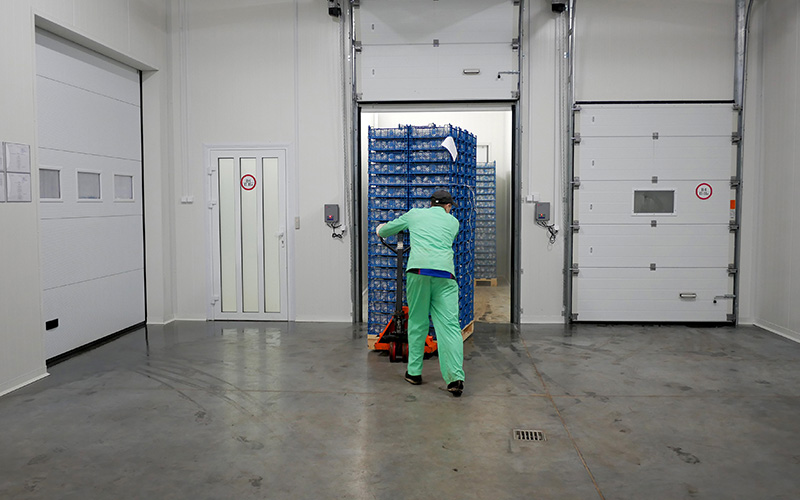
These layout principles work together to stabilize internal temperatures, reduce load on refrigeration systems, and create a more energy-efficient warehouse environment.
Which Refrigeration Systems Maximize Long-Term Efficiency?
Energy-efficient refrigeration systems maintain required temperatures while reducing total power use and operational strain on components.
- Refrigerant Selection: Using natural refrigerants such as ammonia (NH₃) or carbon dioxide (CO₂) improves thermal efficiency because these substances have high latent heat values and low global warming potential. In practice, this means less energy is needed to achieve the same cooling capacity compared to many synthetic refrigerants like hydrofluorocarbons (HFCs). Operators benefit from lower utility costs and easier compliance with tightening environmental standards.
- Variable Speed Compressors: A variable speed compressor adjusts motor speed to match real-time cooling demand. Because it avoids the repetitive start-stop cycle of fixed-speed models, it reduces wear and energy peaks. For the owner, this translates to smoother performance, fewer maintenance intervals, and measurable energy savings during partial load periods.
- Condenser Optimization: Air-cooled and evaporative condensers that use clean coils and adjustable fan controls can maintain proper pressure balance even as ambient temperatures change. This design limits excessive compressor workload, which extends component life.
- Waste Heat Recovery: Many modern refrigeration systems now use heat recovery loops to capture heat from the condenser. That recovered heat can supply underfloor heating or office climate control. In other words, the same energy that once escaped as waste offsets heating costs elsewhere in the facility.
How Do You Minimize Heat Infiltration at Docks and Doors?
Minimizing heat infiltration at docks and doors means keeping temperature-controlled air inside while reducing the entry of outdoor air that raises energy use and affects product quality.
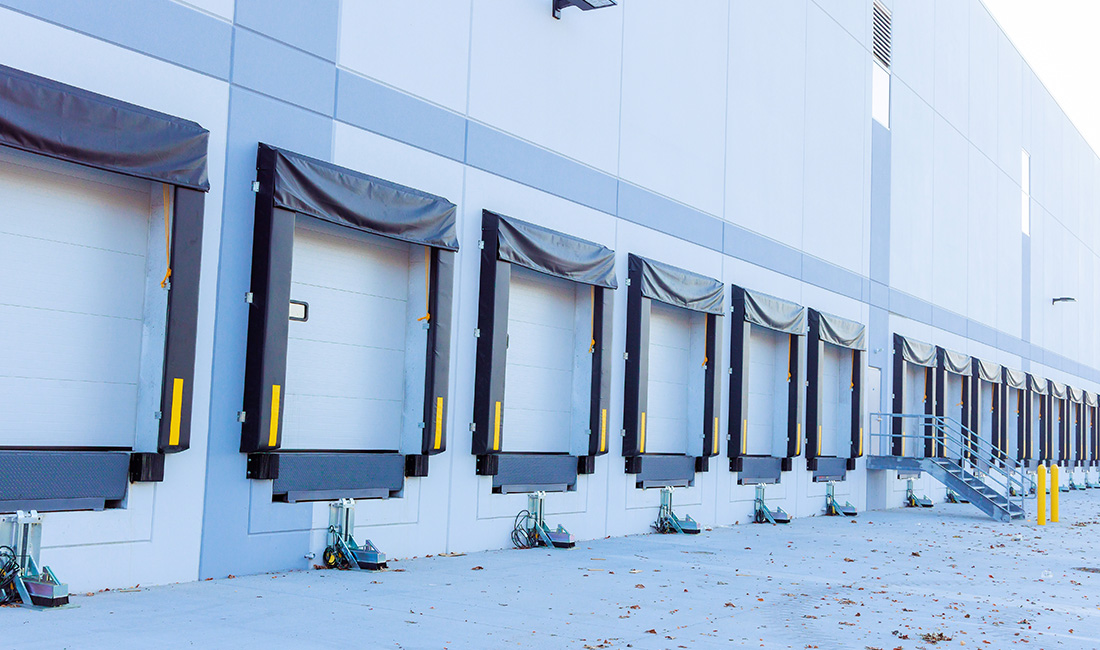
- Dock Seals and Shelters: Using properly sized dock seals made from closed-cell foam or inflatable designs helps close the space between the trailer and building wall. This tight seal limits air leakage and reduces strain on refrigeration units. For the operator, this means less temperature fluctuation during loading and unloading.
- Insulated and Vertical-Storing Doors: Doors with an R-value of 20 or higher restrict heat transfer through insulated panels. Vertical-storing levelers keep the door completely closed when not in use, cutting the open gap that otherwise acts as a thermal bridge. In practice, this keeps the dock face closer to the storage-room temperature.
- High-Speed Doors and Air Curtains: High-speed doors that open and close at 120 inches per second or faster greatly lower the time doors are exposed. Air curtains use a directed airflow barrier to separate warm and cold zones while allowing forklift passage. Together, these tools reduce air infiltration during active operations.
- Automation and AS/RS Systems: Automated storage and retrieval systems (AS/RS) lower the number of door cycles because machines move goods directly between zones. Fewer manual entries mean less opportunity for warm air exchange. For the facility, this translates into steady temperatures and lower compressor runtime.
How Can Secondary Systems Lower the Total Energy Bill?
Secondary systems lower a warehouse’s total energy bill by managing supporting operations—like lighting, ventilation, and monitoring—so the main refrigeration load works less and wastes less power.
- Temperature Monitoring: Real-time monitoring uses calibrated sensors to detect even small temperature drifts. Because adjustments occur immediately through the building management system (BMS), compressors cycle less often. In practice, this prevents overcooling and reduces electricity use while protecting frozen goods.
- Inventory Management: Automated tracking systems help staff organize products by turnover rate. By storing high-frequency items near doors and grouping similar-temperature products, air exchange during loading becomes shorter. This limits warm air inflow and cuts the energy needed to restore set temperatures.
- Ventilation and Humidity Control: Smart fans and desiccant units maintain airflow and moisture at defined setpoints rather than fixed speeds. When humidity drops to target levels, fans slow automatically, conserving both electricity and compressor capacity. For operators, this translates to stable product quality with less dehumidification energy.
- Building Management System: A BMS integrates sensors, lighting, and HVAC components. It regulates power draw based on occupancy and operational schedules. For example, it can dim cold-rated LED lights when aisles are empty or adjust ventilation only where workers are present.
These secondary systems act together to trim peak loads, improve equipment runtimes, and sustain precise environmental conditions with less total power consumption.
Conclusion
Energy efficiency is a long-term operational asset, not just a compliance checklist. Every design choice—from specifying high-performance polyurethane insulation to installing variable frequency compressors—directly impacts your bottom line.
By integrating automation (AGVs) to reduce door cycles and switching to cold-rated LEDs to minimize waste heat, you actively lower the refrigeration load. Furthermore, adopting data-driven management systems allows for predictive maintenance, ensuring your facility remains stable, profitable, and ready for a net-zero future.
Frequently Asked Questions
What are the latest trends in cold storage real estate?
The industry is shifting toward vertical construction near urban centers to shorten delivery times. Key trends include:
- High-Bay Design: Building up instead of out to maximize cubic density.
- Smart Envelopes: Using insulated metal panels (IMPs) and steel framing to eliminate thermal bridging.
- Integrated Tech: Adopting real-time monitoring systems that track energy spikes and ensure HACCP/GMP compliance.
How do vertical storage solutions improve efficiency?
Vertical systems, such as Automated Storage and Retrieval Systems (AS/RS), maximize storage density, meaning you spend less energy cooling “dead air.” High-bay racking also streamlines airflow management, ensuring uniform temperatures across all levels and reducing the workload on refrigeration fans.
What are the best practices for maintaining energy efficiency?
Operational efficiency relies on three core habits:
- Seal Integrity: Regularly inspecting door gaskets and insulation to prevent cold air leaks.
- Smart Lighting: Using motion-sensor LEDs to cut heat and power usage in unoccupied zones.
- Load Scheduling: Scheduling deliveries during cooler parts of the day to lower compressor strain.
How does regional climate impact facility design?
The external environment dictates your insulation strategy:
- Hot & Humid Climates: Prioritize rigorous vapor barriers to prevent condensation and mold.
- Cold Climates: Focus on underfloor insulation and heating to prevent frost heave from cracking the foundation.
- All Regions: Align insulation R-values and renewable energy sources (like solar) with local weather patterns to stabilize costs.
Want to Know More About Our Products?
View All Products Now